In 1855, a silk-weaving factory with 30 looms operated in Shaki. By 1864, the factory had 55 looms and employed 75 workers. In 1961, the factory expanded further, becoming one of the largest factories in the world at the time, equipped with 432 looms powered by steam engines and horse power.
At the beginning of the 20th century, especially in its second decade, the silk industry in Shaki was at a high level of development. Small-scale artisanal workshops gradually disappeared, replaced by large factory-type enterprises that played a significant role in the silk industry. Notably, silk-related events were held in Shaki. In 1909, a silk exhibition-competition took place, and in November 1913, a conference on the reserves of the silk processing industry was organized there.
From the early years of Soviet rule, government authorities implemented significant measures to develop silk production. On June 14, 1926, the Central Committee of the Azerbaijan Communist Party issued a decree to build a large silk-spinning plant in Shaki. Construction began in 1927, and by 1931, the main building for raw silk production was operational. Over the years, new production facilities were commissioned.
Today’s “Azəripək” MMC operates within the factory founded in 1931. Following Presidential Decree №1665 of November 6, 2017, the “Azerbaijan Industrial Corporation” OJSC was established, and on April 13, 2018, its director Kamran Nəbizadə signed a decree establishing “Azəripək” MMC.
The company consists of raw silk production, weaving, dyeing-decorating, cotton-spinning, winding workshops, carpet workshops, and non-production units such as administration, raw material and cocoon sorting, mechanics and energy, and transportation. Significant growth in Azerbaijan’s silk industry began in the 1970s under the guidance of national leader Heydar Aliyev, enhancing technical infrastructure and increasing raw silk supply by 36.1%.
Shaki silk fabrics were exported to Japan, Switzerland, Italy, and other countries. After the collapse of the Soviet Union, raw silk production sharply declined. After Azerbaijan’s independence, measures were taken to restore silk production, including financial support to the former “Shaki-Silk” ASC (now “Azəripək” MMC), with 400,000 AZN allocated in 2001.
Due to raw material shortages, the enterprise could not operate at full capacity, and from 2003 to 2009, it had to import 1,000 tons of raw silk. In 2016, under President Ilham Aliyev’s instructions, mulberry silkworm eggs were imported and distributed to breeders in 24 regions.
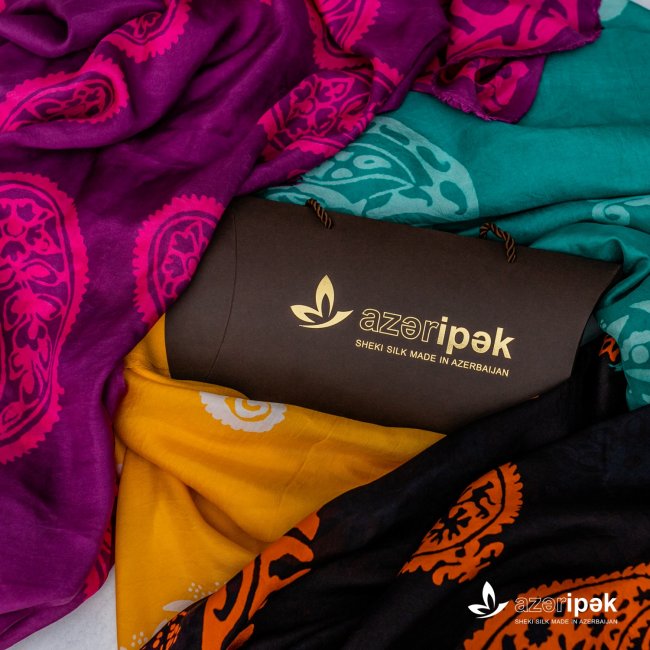
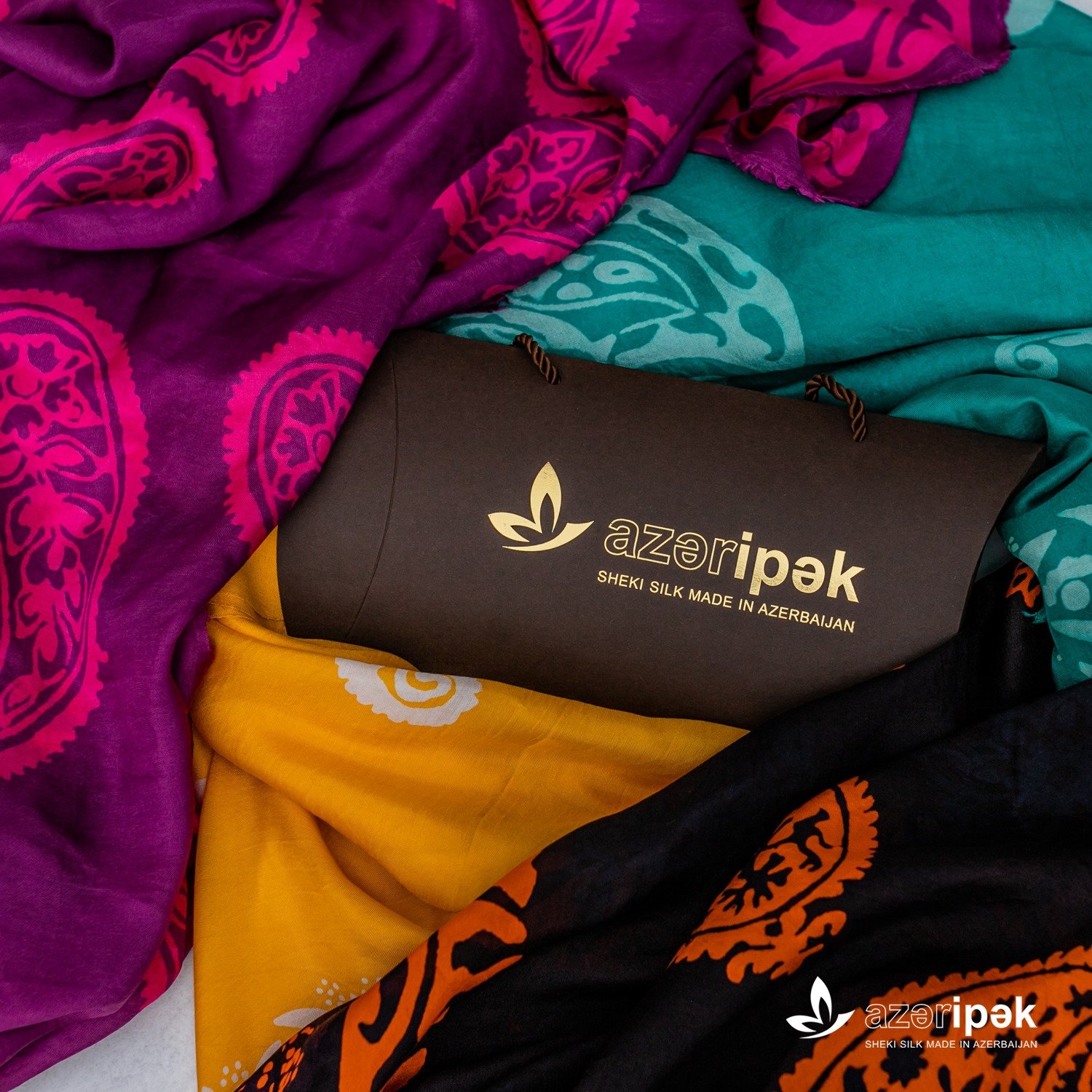
Production statistics for raw silk: in 2015 – 236 kg, 2016 – 70.7 tons, 2017 – 248.8 tons, 2018 – 514 tons, 2019 – 641 tons, 2020 – 446 tons, 2021 – 491 tons. Currently, “Azəripək” MMC operates raw silk production, weaving, dyeing-decorating, winding, and carpet workshops, producing 100% natural high-quality raw silk and various silk products including kəlağayı, scarves, and chitmә.
Products are exported to Turkey, Iran, India, Russia, Ukraine, and other countries.

 +99451 277 72 11

Follow us on social media