
Silk production has always held a special place in the life and daily activities of the people of Shaki. In the Middle Ages, Shaki was considered one of the largest silk producers and weaving centers not only in Azerbaijan but also in the Near and Middle East. This ancient land became famous worldwide for its silk. Colorful kerchiefs made from raw silk by Shaki artisans, carpets woven from silk threads, and delicate fabrics were exported to several countries. The Silk Combine, which started its operations in Shaki in 1931, was one of the largest industrial enterprises in the country.
The development of silk production is a focus of the country's leadershipIn the 1970s-80s, the development of silk production in Azerbaijan, including Shaki, expanded significantly. At that time, around 7,000 workers were employed at the “Shaki-Silk” Combine. However, in the early 1990s, with the collapse of the Soviet Union and disruption of economic ties, the silk industry, including the “Shaki-Silk” Combine, faced a decline. Only after the national leader Heydar Aliyev’s return to power for the second time did the attitude toward silk production fundamentally change, and necessary steps were taken to restore the industry.
Thanks to the direct attention and care of President Ilham Aliyev, essential measures for the development of sericulture and the creation of a modern silk infrastructure in the country have significantly revitalized the activities of “Azəripək” LLC (formerly “Shaki-Silk” JSC), one of the largest industrial enterprises in the northwestern region of Azerbaijan. Since 2016, after many years of interruption, the annual increase in raw silk production has ensured the enterprise’s supply of raw materials and improved its performance.
AZƏRTAC’s regional correspondent visited “Azəripək” LLC and explored the enterprise’s operations.
Last year, 40 tons of raw silk were produced at “Azəripək” LLCAccording to Teymur Musayev, Advisor to the Chairman of the LLC, the enterprise currently operates cocoon processing and dyeing workshops, sorting, and carpet production units. A total of 314 employees work in these workshops. In April, the twisting and weaving workshops are also planned to resume operations, which will increase the number of employees to 400.
The official noted that last year, 446 tons of raw silk cocoons were produced in the country. The available raw material allows the enterprise to operate continuously throughout the year in a single-shift mode. Last year, 40 tons of raw silk were produced. Silk fabrics, kerchiefs, silk scarves, and various head coverings produced here were exported to Turkey, Iran, and India, as well as sold on the domestic market.
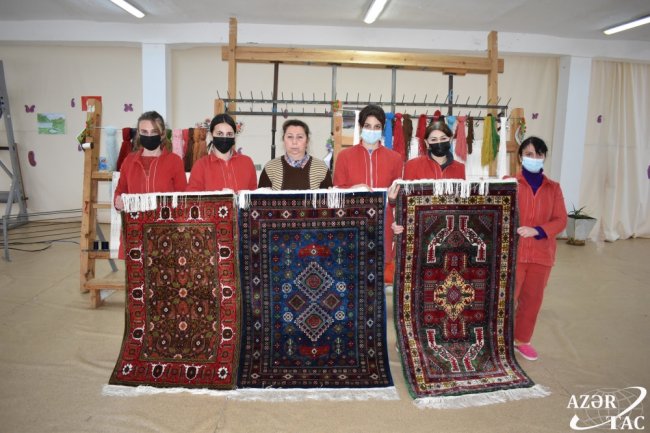
“Azəripək” LLC's silk carpet workshop resumes operationsThe carpet workshop has resumed operations after several months. The manager of the workshop, Gülnaz Nurəhmədova, has been leading this field since a separate silk carpet workshop was established under the enterprise in 2002.
Gülnaz stated that carpet weaving is a family craft passed down through generations. She was born into a family of carpet weavers; her grandmother and mother were also carpet makers. She has been teaching this craft to young women for over 30 years, ensuring that it survives and develops further.
Our interviewee mentioned that when the National Leader visited Shaki in 2002, he took an interest in the Silk Combine and, on his direct recommendation, a silk carpet weaving workshop was created alongside other production units. Initially, about 120 workers were employed in the workshop. Later, due to a shortage of raw material, i.e., silk threads, the workshop temporarily ceased operations. The carpet workshop resumed its activities in September 2020. Currently, five weaving looms are in operation, and five weavers are employed. During this period, five silk prayer rugs have been woven, and the weaving of five more rugs representing the Quba, Shirvan, and Karabakh regions has begun. The sizes of the woven rugs are 70x110 cm and 100x135 cm. One of the newly woven carpets will feature the Khari Bulbul, a symbol of Karabakh's liberation.
One square meter of silk carpet contains 490,000 knotsAccording to Gülnaz Nurəhmədova, the silk carpets woven in the workshop differ significantly from those produced abroad, with much higher density. One square meter of silk carpet contains 490,000 knots. Weaving a silk carpet from silk threads is very time-consuming. A one-square-meter carpet is woven by two people in three months. The silk threads are produced in-house and dyed in the dyeing workshop. In the past, carpets depicting Shaki’s historical monuments, including the Khan Palace, were also woven in the workshop. In the future, carpets related to Shaki will continue to be woven.
The number of employees will increase as raw materials become availableThe workshop manager noted that as raw silk supplies increase and previously used weaving looms are put back into operation, the number of employees will rise.
Currently, the weavers working in the workshop have prior experience in the field. Gülnarə Kərimova, Samirə Məmmədova, Adilə Mustafayeva, Samilə Rzayeva, and Vəfa Səfərova have been weaving carpets for many years and are master craftsmen in their profession. During discussions with the employees, they expressed gratitude on behalf of the team to the head of state for the attention and support given to the development of sericulture and the restoration of the enterprise’s activities.
AZƏRTAC




 +99451 277 72 11

Follow us on social media